Showing posts with label Falun Gong. Show all posts

24 March, 2010

Google stops China censorship...

Google China's logoImage via Wikipedia

Google stops China censorship, Beijing condemns move
Posted: 23 March 2010 1508 hrs


WASHINGTON - A day after Google said it would no longer censor its search engine results in China, angering Beijing, Chinese access to websites covering sensitive topics remained blocked Tuesday.

Google announced Monday in a blog post that it had shifted mainland Chinese users of its Google.cn search engine to an uncensored site in the former British colony Hong Kong, drawing anger from Beijing and raising questions about the Web giant's future in the world's biggest online market.

But Tuesday, searches from mainland computers of subjects like "Falun Gong" and "June 4" -- referring to the Tiananmen pro-democracy protests in 1989 -- produced the message: "Internet Explorer cannot display the web page."

-----

A stand builder fixes a Google logo at an exhibition booth

-----

The same searches on Google.com.hk from computers in Hong Kong displayed full results -- suggesting that China was deploying its "Great Firewall" of web censorship.

While ending censorship in China, the Mountain View, California-based Google said it planned to keep sales, research and development teams in the country of some 384 million Internet users.

Google's decision came a little more than two months after the Internet titan threatened to close its Chinese operations because of censorship and cyberattacks it said originated from China.

China said Google was "totally wrong" to stop censorship and blame Beijing for the cyberattacks that allegedly targeted the email accounts of Chinese human rights activists.

"Google has violated its written promise it made when entering the Chinese market by stopping filtering its searching service," said the official in charge of the Internet bureau of the State Council Information Office.

"We're uncompromisingly opposed to the politicization of commercial issues, and express our discontent and indignation to Google for its unreasonable accusations and conduct."

The White House said it was "disappointed" Google could not reach a deal with Beijing and reiterated that US President Barack Obama is "committed to Internet freedom and... opposed to censorship."

Drummond, Google's top lawyer, said "figuring out how to make good on our promise to stop censoring search on Google.cn has been hard.

"We very much hope that the Chinese government respects our decision, though we are well aware that it could at any time block access to our services."

Google co-founder Sergey Brin told The New York Times that shifting the Chinese service to Hong Kong was not given a clear-cut stamp of approval by Beijing but "there was a sense that Hong Kong was the right step."

"There's a lot of lack of clarity," he said. "Our hope is that the newly begun Hong Kong service will continue to be available in mainland China."

Drummond said "the Chinese government has been crystal clear throughout our discussions that self-censorship is a non-negotiable legal requirement."

He said providing uncensored search from Hong Kong is "entirely legal and will meaningfully increase access to information for people in China."

Beijing tightly controls online content, removing information it deems harmful such as pornography and violent content, but also politically sensitive material.

Google launched Google.cn in January 2006 after agreeing to censor websites for content banned under Chinese law. Google.cn is the second-largest search engine in China after Chinese search engine Baidu.com.

Google's decision to end censorship in China was welcomed by human rights and technology groups and US lawmakers.

"It is a remarkable, and welcomed, action and an important boost of encouragement for millions of Chinese human rights activists and political and religious dissidents," said US Representative Christopher Smith, a Republican
from New Jersey.

Arvind Ganesan, business and human rights director at Human Rights Watch, called it "an important step to challenge the Chinese government's use of censorship to maintain its control over its citizens."

"Google has taken a courageous position against censorship," said Lucie Morillon of Paris-based media rights group Reporters Without Borders.

Leading Chinese dissident Wei Jingsheng, who spent nearly two decades in prison and now lives in the United States, said he knew China "would not back down."

"But we also knew that Google's motto was 'Don't be evil.' So there was no point on which to compromise," Wei said.

Leslie Harris, president of the Center for Democracy & Technology, praised what she called Google's "continued effort to enable China's people with unfiltered access to robust sources of information from all over the world."

- AFP/ir

From ChannelNewsAsia.com; see the source article here.

----------


Reblog this post [with Zemanta]

01 July, 2009

Report: China extends deadline on filtering software

Updated 1 hour, 18 minutes ago

By Steve Mollman

For CNN

Story Highlights

  • NEW: China extends deadline for filtering software to accompany PCs
  • Government says Green Dam software is designed to block porn
  • Critics say software can block all non-government sanctioned content
  • Green Dam has been dogged by tech glitches

PC makers are being ordered to include software that could affect the quality of their products.

(CNN) -- China has announced it would indefinitely postpone a mandate requiring all personal computers sold in the country to be accompanied by a controversial content-filtering application, state media reported.

The Tuesday announcement came one day before a government-set deadline that would have required the software, called Green Dam-Youth Escort, to come with all PCs, according to the official Xinhua news agency.

The Chinese government has said the software is chiefly a way for parents to protect children from pornography. But a wide range of outside parties have expressed concern about the software.

A letter was sent directly to Premier Wen Jiabao on June 26 and signed by an international group of more than 20 business associations including the Business Software Alliance, Consumer Electronics Association and both the U.S. and EU chambers of commerce.

China's central government announced in May that the Green Dam software package must accompany all new computers in China. Citing China's Ministry of Information Technology, China Daily recently reported the government policy came "in response to calls from many schools and parents."

The number of people online in China has swelled in recent years. The nation surpassed the United States in 2008 as the world's top user of the World Wide Web, according to a Chinese government-backed research group.

Critics of the application say it is capable of causing glitches when a PC user types or encounters "forbidden" political content. And some independent researchers have demonstrated that the application has programming errors that expose users to security risks.

A June 11 report by researchers at the University of Michigan stated that because of security vulnerabilities, "any Web site a Green Dam user visits can take control of the PC."

A week later the researchers re-investigated the program after the software maker, the Jinhui Computer System Engineering Co., dispatched a patch designed to fix at least some of the problems.

"Despite these attempts to make the software secure," they wrote, "we found a new remotely exploitable vulnerability in the patched program. It took us just over an hour to find this new vulnerability."

Meanwhile, Hal Roberts, a Harvard University researcher, showed how the program could freeze a browser every time the user types the letter F into the location bar.

In his demonstration posted on YouTube, this happened after the letter became associated via the browser's auto-complete list with the Web site falundafa.org, which is related to Falun Gong, the religious sect banned in China.

Through Green Dam's auto-update feature, authorities can keep PCs current on which content is forbidden.

"If you operate an Internet business in China, you know there are really only two topics to avoid," according to Richard Lim, a managing partner at Beijing-based venture capital fund GSR Ventures.

"You avoid politics -- especially certain types of politics -- and you avoid pornography. Pretty much everything else is fair game."

On Chinese-language blogs and other sites, according to Lim, there has been a lot of discussion about Green Dam and the company that created it for the government.

According to the Web site of China Daily, the country's official English-language newspaper, the government paid Jinhui Computer System Engineering Co. a little over $6 million for the development, future maintenance and updates of the software.

The software, which is for Windows only, is not noteworthy in a technical sense, according J. Alex Halderman, one of the researchers and a professor at the University of Michigan.

"Its main features are keyword and URL-based filtering, image recognition, and contextual phrase recognition, all of which have been used before by other filtering programs," he noted in an email.

"Blocking political speech isn't even unprecedented--some filtering software used in the U.S. allows parents to block categories of sites with certain political leanings."

What's unusual, he noted, is "for a government to license one particular software product and then require PC makers to ship it."

The Open Net Initiative, an academic consortium focused on censorship and surveillance, reported that it was "unprecedented" for a government to demand, at an individual level, nationwide use of a particular company's software.

Concern about the software goes beyond censorship watchdogs. PC makers are being ordered to include software that could affect the quality of their products.

A June 24 letter from the U.S. Department of Commerce to the Chinese government listed "numerous concerns raised by global technology companies, Chinese citizens, and the worldwide media about the stability of the software, the scope and extent of the filtering activities and its security weaknesses."

Despite such communication, there has been no indication so far from the Chinese government that the rule will be revoked, only delayed.

PC makers, then, may eventually find themselves stuck between a rock and a hard place. On the one hand China's large market is rather difficult to ignore. According to research firm Gartner, last year about 14 percent of the world's PC sales occurred in China, and that number should increase to almost 16 percent by 2012.

But by including Green Dam, they, for starters, leave themselves open to quality issues and accusations of abetting censorship.

From CNN.com; see the source article here.

Reblog this post [with Zemanta]

26 June, 2009

Not Yahoo!'s job to 'fix China', says CEO

Image representing Carol Bartz as depicted in ...Image via CrunchBase

Posted: 26 June 2009 0646 hrs

Pedestrians walk past a Yahoo! billboard in Beijing. (file pic)

WASHINGTON: Yahoo! chief executive Carol Bartz staunchly defended the Internet company's business practices in China on Thursday and said it was "not our job to fix the Chinese government".

Bartz, appearing at her first shareholders meeting since taking over the Sunnyvale, California-based company in January, said Yahoo! respects human rights.

"We actually hosted a business and human rights summit for high tech companies a month or so ago," she said. "Yahoo! has gone overboard on this point to really be sympathetic, serious and so forth.

"We have done a lot," she said.

"The board does its best, the company does its best to run a good business, to look out for our population around the world, both the people who work for us and the people who come to visit us," she said. "That's our commitment."

Bartz added that Yahoo! "was not incorporated to fix China".

"It was incorporated to give people a free flow of information," she said.

A number of US companies, including Microsoft, Cisco, Google and Yahoo!, have been hauled before the US Congress in recent years and accused of complicity in building what has been called the "Great Firewall of China".

Yahoo! was thrust into the forefront of the online rights issue after the company helped Chinese police identify cyber dissidents whose supposed crime was expressing their views online.

Alluding to the case, Bartz said: "Ten years ago the company made a mistake, and you can't hold us up as the bad boy forever.

"We have worked better, harder, faster than most companies to respect human rights and to try and make a difference," she said.

"But it is not our job to fix the Chinese government, it's that simple.

"We will respect human rights, we will do what's right, but we're not going to take on every government in the world as our mandate," she said. "That's not the mandate that the shareholders gave us."

Yahoo!, other technology giants and a coalition of human rights and other groups unveiled a code of conduct last year aimed at safeguarding online freedom of speech and privacy.

China exercises strict control over the Internet, blocking sites linked to Chinese dissidents, the outlawed Falun Gong spiritual movement, the Tibetan government-in-exile and those with information on the 1989 Tiananmen massacre.

China and Google are currently engaged in a dispute, with Beijing accusing the Internet giant of providing links to pornography in its Web searches.

And the United States called on China on Wednesday to drop a new requirement for all computers to carry Internet filtering software.

Commerce Secretary Gary Locke and US Trade Representative Ron Kirk said China may be violating World Trade Organisation obligations by requiring that all computers sold in the country from July 1 have the "Green Dam" program.

Beijing said the software will filter out pornography, protecting young people within the world's largest online population.

- AFP/so

From ChannelNewsAsia.com; see the source article here.

Reblog this post [with Zemanta]

24 June, 2009

China says unpopular filtering software optional

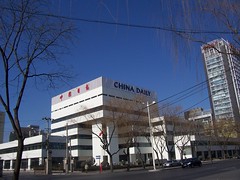
china dailyImage by doubleaf via Flickr

Late post, but this is the other side of the coin…

----------

05:55 AM Jun 17, 2009

BEIJING - China appeared to cave in to public pressure yesterday by announcing that computer users are not required to install Internet-filtering software - though it will still come with all PCs sold on the mainland.

When contacted, a Ministry of Industry and Information Technology official said that use of the Green Dam Youth Escort software is "not compulsory".

This apparent reversal by the government, which said the new software must be packaged with all computers sold in China beginning July 1, marked a small victory for a burgeoning anti-censorship movement in China.

The government says the software is aimed at blocking violence and pornography, but users who have tried it say it prevents access beyond those topics to discussions of homosexuality, images of comic book characters, mentions of the banned Falun Gong spiritual group and, according to Hong Kong media reports, images of pigs because the software confuses them with naked human flesh.

The official China Daily newspaper trumpeted the news on its front page, quoting an official as saying the government's role was "limited to having the software developed and providing it free''. AP

From TODAY, World – Wednesday, 17-Jun-2009; see the source article here.

Reblog this post [with Zemanta]