Showing posts with label Television. Show all posts

10 March, 2011

Our gadgets and their before-bed bad effects

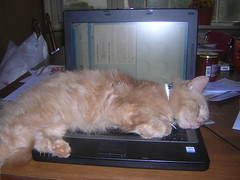
Salem3Image by rabbit57i via FlickrGot this article from CNet news. It is about the negative impact of our gadget-using, especially before going to bed.

Read on.
-----
March 7, 2011

If you're having trouble getting a solid night's sleep, the blame may rest on all the gadgets you're using.

A whopping 95 percent of Americans use some kind of technology an hour before they go to sleep, the National Sleep Foundation found in a poll released today. The organization said Americans are turning on their televisions, mobile phones, computers, or video game devices before bed "at least a few nights a week."

The problem: using technology before bed can negatively affect a person's ability to fall asleep and to get the amount of sleep they need.

"Artificial light exposure between dusk and the time we go to bed at night suppresses release of the sleep-promoting hormone melatonin, enhances alertness and shifts circadian rhythms to a later hour--making it more difficult to fall asleep," Dr. Charles Czeisler, a professor at Harvard Medical School, said in a statement. "This study reveals that light-emitting screens are in heavy use within the pivotal hour before sleep."

When it comes to television before bed, age is a distinguishing factor. The National Sleep Foundation said that 67 percent of baby boomers watch TV every night or nearly every night an hour before they try to sleep, while 63 percent of Generation X folks do the same. Half of all people between the ages of 13 and 18, also known as Generation Z, watch television every night, while 49 percent of Generation Y--folks between 19 and 29--say they flick on their set.

With other devices, however, Generation Y and Generation Z lead the way.

The National Sleep Foundation found that 61 percent of Americans use a laptop or computer an hour before they go to bed. Generation Z and Generation Y were most likely to engage in that activity with 55 percent and 47 percent of people in those groups saying they use a computer before bed, respectively. Generation Z and Generation Y members are nearly twice as likely as baby boomers to play a video game an hour before trying to go to sleep, the organization said.

The National Sleep Foundation also examined mobile-phone use before bed. And not surprisingly, 56 percent of Generation Z users and 42 percent of Generation Y respondents send or receive text messages an hour before going to sleep. Just 15 percent of Generation X and 5 percent of baby boomers do the same.

Use of technology prior to bed can affect more than just sleep, researchers say.

Lauren Hale, an assistant professor at Stony Brook University Medical Center, said that the "higher use of these potentially more sleep-disruptive technologies among younger generations may have serious consequences for physical health, cognitive development and other measures of well being."

Hale's comments follow a study released in The Journal of Clinical Endocrinology & Metabolism in January that found light at night can cause high blood pressure and diabetes. Even more disconcerting, a study released last year by the University of Haifa found that light at night can increase cancer risks, as well.

"Exposure to LAN (light at night) disrupts our biological clock and affects the cyclical rhythm that has developed over hundreds of millions of evolutionary years that were devoid of LAN," researchers at the University of Haifa said at the time. "Light pollution as an environmental problem is gaining awareness around the world, and the World Health Organization...has already classified working the night shift as a higher grade of cancer risk."


Taken from below article:
All that tech is hurting your sleep, researchers say


Enhanced by Zemanta

24 June, 2009

The future of TV looks like this...

Singapore Telecommunications LimitedImage via Wikipedia

05:55 AM Jun 17, 2009

Imagine trying to explain the unique Peranakan culture to friends around the globe, as you watch an episode of The Little Nyonya in an online setting. You'll share your thoughts in a chat-box as the show runs on a souped-up television set, or a computer, or even a mobile device hooked up wirelessly to the Internet.

The work seems cut out for the consortium of companies that will be part of the FutureTV initiative aiming to make such scenarios a reality, under the Singapore Media Fusion Plan - a new national blueprint by the Media Development Authority (MDA).

MDA chief executive Dr Christopher Chia told Today this builds on the previous Media 21 blueprint launched in 2003. He said: "It gears Singapore companies to respond to fresh opportunities in today's new world order by enabling the creation of new Asia media - be it content, services or applications - that resonate with the world, while leveraging on Singapore's strengths and strategic location as an East-West gateway."

Along with $230 million worth of funding from the Government, the new plan outlines three key strategies: Creating a conducive environment for media businesses; leveraging research and development to help the media sector take advantage of new opportunities in digital media; and finally, to make Singapore-made content, media applications and services shine in the global spotlight.

Major players in the technology, infocomm and media sectors have formed the FutureTV consortium that will use Singapore as a test-bed for a new generation of visual media experiences and applications.

It includes media companies like MediaCorp and PGK, telcos SingTel and StarHub, and technology companies like Microsoft and Motorola.

The consortium will be launching the first call for proposals to local technology and media companies to submit novel ideas, technologies and business models.

Mr Shaun Seow, MediaCorp's deputy chief executive, said: "It holds out the promise of a new television viewing experience that's more engaging and interactive, delivered online or via the next generation broadband network that's being built."

The media sector will also see MDA and SingTel partnering to link Mediapolis@one-north - an upcoming self-contained 19-hectare media park incorporating a soundstage, digital production studios and other facilities - with a broadband connection to the telco's Broadcast Innovation Centre at its Satellite Earth Station in Bukit Timah.

This will provide the companies at the media park a digital communications gateway to distribute their content cost-effectively to over 40 major media centres in the world, via satellite and terrestial fibre networks. With this in place, the MDA aims to extend the reach of local media companies and facilitate worldwide access for Asian content. HEDIRMAN SUPIAN

From TODAY, Hot News – Wednesday, 17-Jun-2009; see the source article here.

Reblog this post [with Zemanta]

15 June, 2009

Americans can see clearly now...

The switch from analogue to digital went smoother than expected, says FCC

THE NEW YORK TIMES, AGENCIES

American households proved mostly ready for the transition, with the FCC receiving only some 400,000 calls over the weekend from those confused about the move.
EPA

LOS ANGELES - As the clock ticked down to midnight on Friday, the deadline for the decade-long US$2-billion ($2.9-billion) effort for local television stations in the United States to stop broadcasting in analogue and to usher in a new era of crystal-clear digital television, the calls started to pour in - but there were far fewer than expected.

An estimated 400,000 calls were received by a federal hotline over from people confused about the move to drop analogue TV signals and broadcast only in digital.

The Federal Communications Commission (FCC) said that the help line received about 317,450 calls on Friday and 102,000 on Saturday. This is well below the 600,000 to 3 million callers that the FCC had expected would call on transition day.

For most American viewers, the transition amounted to a minor hiccup at most.

But the industry estimated that 12 million homes had not installed the necessary converter boxes, putting them at risk of losing TV broadcasts altogether.

Across the country, TV stations set up help lines and community organisations held events to aid confused viewers.

Most stations didn't receive the flood of calls they had expected, a sign that the transition was smoother than many had predicted.

About a third of Friday's calls to the FCC were still about federal coupons to pay for digital converter boxes, an indication that at least 100,000 people still didn't have the right equipment to receive digital signals. Another third of the calls were about how to operate the converter boxes. And over 20 per cent of the calls were about reception issues.

As with the transition from typewriter to a computer, the digital TV switch revealed a number of unexpected side effects. Because digital signals are more apt to be affected by interference, many viewers in rural areas said they could see fewer stations than

before.

"Digital signals are sometimes more finicky than analogue signals," said Mr Rick Kaplan, an FCC spokesman. "It may take some time to find the exact right position for your antenna."

A weakly received analogue channel might be viewable through some static, but the channels that broadcast in the digital language of ones and zeros are generally all or nothing.

Most American households now pay for TV through a cable or satellite company. They were mostly unaffected by the switch, which will allow state-of-the-art wireless services and emergency communications to exist on the newly available analogue spectrum space. But millions still watch free TV with an antenna, and they have borne the burden of the digital transition.

While TV is primarily an entertainment medium, US government officials are emphasising its use in emergencies.

The transition was originally scheduled for Feb 17 but was delayed at the last-minute by Congress and US President Barack Obama in a bid to prepare more homes for the switch.

The government has been providing Americans who rely on over-the-air signals with a US$40 coupon to defray the cost of buying a digital converter box.

The FCC has issued 59 million coupons for the converter boxes and will continue to supply them until July 31.

From TODAY, World –Monday, 15-Jun-2009

Reblog this post [with Zemanta]

US stations shift from analog to digital TV

Caricature of Milton Berle by Sam Berman from ...Image via Wikipedia

A late posting… but here goes anyway…

----------

06/13/2009 | 04:30 PM

NEW YORK – TV shows were replaced by the hiss of static in perhaps 1 million US homes Friday (Saturday in Manila) as stations ended their analog broadcasts and abandoned the transmission technology in use since the days of Milton Berle, Sid Caesar, and Howdy Doody.

The vast majority of households that rely on antennas for their TV signals were prepared for the shutdown, but many people remained vexed by the challenge of setting up digital reception.

Hundreds of people began lining up about 3 a.m. Friday outside the Freestore Foodbank in Cincinnati, five hours before the agency began giving out 250 free digital converter boxes. The center had given all the converters away by 10:30 a.m., and many people were still in line.

Harvey Durrett, 48, said he got in line about 6 a.m. but was unable to get a converter, which costs about $40 to $60 in electronics stores unless the consumer has a $40 coupon from the government.

"I'm on disability, and I can't really afford to buy one," Durrett said. "I can't get anything on my TV now, so I guess I'll have to go to friends' houses if I want to watch anything."

Any set hooked up to cable or a satellite dish is unaffected by the end of analog broadcasts, but around 17 million US households rely on antennas. Nielsen Co. said poor and minority households were less likely to be prepared for Friday's analog shutdown, as were households consisting of people younger than 35.

TV stations were free to choose when in the day to cut their signals, and many were holding off until late at night. That means the full effect of the shutdown will not be apparent until this weekend.

At WTTG, a Fox affiliate in Washington, the 11 a.m. newscast concluded with the signoff used when the station was a part of the old DuMont Broadcasting Network – playing "The Star-Spangled Banner," followed by a test signal. Then at noon, the station showed an engineer pushing a red button to shut off the analog broadcast.

TV stations, electronics stores and the government said most of the calls they received Friday were from people who had converter boxes, but needed help setting them up.

Fox affiliate WUPW in Toledo, Ohio, cut its signal at 8 a.m., making it one of the first stations to go. By 5:45 p.m., the station's five-person phone bank had received about 170 calls.

Chief engineer Steve Pietras said many callers had put off hooking up their converter boxes because they thought that digital broadcasting did not start until Friday. Like most stations, WUPW has been broadcasting digitally for years, alongside analog.

"That's kind of causing some last-minute jitters in a lot of people," Pietras said.

The Commerce Department reported a last-minute rush for the $40 converter box coupons: It received 319,990 requests Thursday, nearly four times the daily average for the past month. In all, the government has mailed coupons for almost 60 million converter boxes. The limit is two coupons per household.

It takes nine business days for a coupon to reach the mailbox. Leo Jones, a 79-year-old retired school administrator in Ontario, Calif., was chagrined to learn this Friday. His coupon will not get to him in time for the fifth game of the NBA playoffs on Sunday, when the Los Angeles Lakers could be crowned champions.

"I'll have to visit my neighbor," Jones said. "I would rather watch it at home."

The government is accepting coupon requests and offering technical support at 1-888-CALL-FCC. Federal Communications Commission spokesman Mark Wigfield said that by 2 p.m. Friday, the agency had received 122,389 calls, nearly four times as many as on Thursday, the busiest day so far.

Among several confusing elements to the transition, many stations were moving to new frequencies Friday. That means that even digitalTV sets and older sets hooked up to converter boxes need to be set to "re-scan" the airwaves. New TVs and the converter boxes have menu options, accessible through their remote controls, to enable a re-scan.

Some people might also need new antennas, because digital signals travel differently than analog ones.

A weakly received analog channel might be viewable through some static, but channels broadcast in the digital language of ones and zeros are generally all or nothing. If they do not come in perfectly, they are blank or show a stuttering picture that breaks apart into blocks of color.

The shutdown of analog channels opens part of the airwaves for modern applications like wireless broadband and TV services for cell phones. The government reaped $19.6 billion last year by selling some of the freed-up frequencies, with AT&T Inc. and Verizon Wireless the biggest buyers.

The shutdown was originally scheduled for Feb. 17, but the government's fund for converter box coupons ran out of money in early January, prompting the incoming Obama administration to push for a delay. The converter box program got additional funding in the national stimulus package.

Research firm SmithGeiger LLC said Thursday that about 2.2 million households were still unprepared as of last week. Sponsored by the broadcasters' association, it surveyed 948 households that relied on antennas and found that 1 in 8 did not have a digitalTV or digital converter box.

Nielsen Co., which measures TV ratings from a wide panel of households, put the number of unready homes at 2.8 million, or 2.5 percent of the total television market, as of Sunday. In February, the number was 5.8 million.

Both the Nielsen and SmithGeiger surveys counted households as unprepared even if they have taken some steps toward getting digital signals, like ordering a converter box coupon.

Nearly half of the nation's 1,760 full-power TV stations had already cut their analog signals even before Friday, mostly in less populated areas.

Even after Friday, low-power analog stations and rural relay stations known as "translators" will still be available in some areas. And about 100 full-power stations will keep an analog "night light" on for a few weeks, informing viewers they should switch to digital reception.

The change also put a few stations off the air temporarily, making them available only through cable and satellite. In Syracuse, New York, NBC affiliate WSTM shut down both analog and digital signals at midnight. The digital signal will be restored this weekend, after the station completes its work to move to a new frequency, said Laura Hand, community relations director for the station.

WGTU in Traverse City, Michigan, was off the air at midday and was working to come back up before the Detroit Red Wings played Game 7 of the Stanley Cup on Friday night.

"We do have some folks here that we don't want to disappoint," said Jill Saarela, the head of the station. - AP

From GMANews.tv; see the source article here.

Reblog this post [with Zemanta]

29 May, 2009

Microsoft launching Zune HD

Posted: 28 May 2009 1544 hrs

Microsoft's Zune music players

WASHINGTON - Microsoft plans to release a new version of its portable Zune music player later this year featuring a touch screen, Web browser, Wi-Fi connectivity and high-definition radio receiver.

The Redmond, Washington-based software giant said late Tuesday that the Zune HD, Microsoft's rival to the hot-selling Apple iPod, would be available in the United States before the end of the year.

It did not say how much it would cost.

Microsoft said the device would feature high-definition video output capability which would allow it to play HD quality video on HD televisions using a docking station.

Microsoft also said it was integrating the Zune with its Xbox Live video offerings "bringing an exciting catalog of TV and film to the platform."

"This marks an important development in the Zune strategy and brings the Zune brand to more than 17 million international Xbox Live subscribers," Microsoft said.

It said the integration of Zune and Xbox Live would be demonstrated at next week's Electronic Entertainment Expo (E3) in Los Angeles. - AFP/sh

From ChannelNewsAsia.com; see the source article here.


Reblog this post [with Zemanta]

22 May, 2009

20 hours of video uploaded to YouTube every minute

Posted: 21 May 2009 2200 hrs

WASHINGTON - YouTube just keeps getting bigger. The Google-owned video-sharing site said late Wednesday in a blog post that 20 hours of video are being uploaded to YouTube every minute.

It said that in mid-2007, six hours of video were being uploaded to the site every minute. It grew to 15 hours in January of this year and now stands at 20 hours a minute, YouTube said.

"Let's see if we can get to 24 hours -- a full day's worth of video uploaded every minute," wrote Ryan Junee, a YouTube product manager.

Google bought YouTube in 2006 for 1.65 billion dollars but the Mountain View, California-based Internet search and advertising giant has not yet managed to turn a profit with the site despite its massive global popularity.

YouTube has been gradually adding professional content such as full-length television shows and movies to its vast trove of amateur video offerings in a bid to attract advertisers.

It recently announced partnerships with Sony Pictures and other Hollywood studios and rolled out new platforms for watching television shows and movies.

- AFP/ir

From ChannelNewsAsia.com; see the source article here.


Reblog this post [with Zemanta]

18 May, 2009

Samsung puts its money on LED

REVIEW SAMSUNG B7000 Full-HD LED TV

090515-SamsungB7000 Enjoy higher contrast and enhanced efficiency on this media-friendly television set

Hedirman Supian, hedirman@mediacorp.com.sg

FLAT-PANEL television sets are becoming a commodity, no thanks to sliding prices. But how can manufacturers differentiate their products to lure the picky consumer? Well, electronics giant Samsung has gone the extra mile this time with its new series of LED-based full high-definition television sets.

Divided into three lines (the 8000, 7000 and 6000), the series employs light-emitting diodes (LEDs), instead of conventional cold cathode fluorescent lamps (CCFLs), for backlighting. LED technology makes the sets slimmer, increases the screen contrast and enhances energy efficiency.

The 40-inch model from the B7000 series appears amazingly svelte, looking thinner than the 3cm it actually measures at its thickest point. The only drawback was that it took quite a shove for some of the thicker cables to be plugged in, as the ports are positioned in such a manner that they are almost flush with the back surface.

Samsung has categorised the product’s interactive and content features under what it calls Medi@2.0, which includes Internet@TV, Content Library, USB 2.0 Movie and DLNA Wireless. Like its recent predecessor, the B7000 incorporates a range of pre-loaded content dubbed the Content Library. It includes a picture gallery, games, as well as cooking and fitness programmes.

You can download new content online and delete content you no longer need. USB 2.0 lets you hook up USB-based storage to view JPEG images, listen to MP3s, or watch movies. Its DNLA Wireless feature lets you access media on other DNLA-compatible devices, like the Sony PlayStation 3, mobile phones and computers. We loved the built-in YouTube feature because it provided a wealth of easily-accessible content. The movies on the online video-sharing site loaded fast and looked great even on the 40-inch TV.

With the TV being so reliant on networking and Internet connectivity for so many of its interactive features and content, we like the fact that Samsung is bundling a free wireless USB dongle with each set.

In terms of performance, the TV offered a marked difference in contrast, allowing you to see textures and details in dark scenes. While the display brightness was way above average, we noticed some over exposure in brightly-lit conditions and had to tone down the settings. Fast-moving action scenes weren’t as smooth as expected when it came to movies at 1080p resolution. There was slight fuzziness, but it was a non-issue over time when we started playing action games at 1080p using a PlayStation 3. The TV also ran much cooler than other sets we’ve reviewed before.

Apart from the long remote that allows for total control of the B7000, you get a mini-remote that lets you adjust the volume and switch channels. This was a nice touch, but with the plethora of cable boxes and other home theatre equipment hooked up to the TV, you’ll be better off with the full-featured remote, which also has a nifty backlight that allows you to use it in the dark.

The Samsung B7000 series ($5,399) shows that there’s still much room for improvement for TVs when it comes to bundling it with content and Internet connectivity. The added YouTube feature is a first for a TV and the device’s media-friendly features certainly make it easy for you to access content without the hassle of hooking it up to a computer or media centre.

From TODAY, Tech; Friday, 15-May-2009


Reblog this post [with Zemanta]

Power-hungry gadgets cause alarm

ENERGY CONSUMPTION

Soaring electricity needs of home electronics a threat to environment

PARIS - Charge your iPod, kill a polar bear?

The choice might not be quite that stark, but an energy watchdog is alarmed about the threat to the environment from the soaring electricity needs of gadgets like MP3 players, mobile phones and flat screen TVs.

In a report released on Wednesday, the Paris-based International Energy Agency (IEA) estimates new electronic gadgets will triple their energy consumption by 2030 to 1,700 terawatt hours, the equivalent of today’s home electricity consumption of the United States and Japan combined.

The world would have to build around 200 new nuclear power plants just to power all the TVs, iPods, PCs and other home electronics expected to be plugged in by 2030, when the global electric bill to power them will rise to US$200 billion ($294 billion) a year, the IEA said.

Consumer electronics is “the fastest growing area and it’s the area with the least amount of policies in place” to control energy efficiency, said Mr Paul Waide, a senior policy analyst at the IEA.

Electronic gadgets already account for about 15 per cent of household electric consumption, a share that is rising rapidly as the number of these gadgets multiplies.

Last year, the world spent US$80 billion on electricity to power all these household electronics, the IEA said.

----------

More TVs, higher consumption

The IEA estimates the world will soon have 2 billion TVs in use, or an average of 1.3 televisions for every household with electricity. In addition to becoming more numerous, TVs are also getting bigger screens and are being left on for longer each day. The group predicts 5 per cent annual increase in energy consumption between 1990 and 2030, just from TVs alone. AP

----------

Most of the increase in consumer electronics will be in developing countries, where economic growth is fastest and ownership rates of gadgets is the lowest, Mr Waide said.

“This will jeopardise efforts to increase energy security and reduce the emission of greenhouse gases” blamed for global warming, the agency said.

Existing technologies could slash gadgets’ energy consumption by more than 30 per cent at no cost, or by more than 50 per cent at a small cost, the IEA estimates, meaning total greenhouse gas emissions from households’ electronic gadgets could be held stable at around 500 million tonnes of Carbon Dioxide per year.

If nothing is done, this figure will double to around 1 billion tonnes of Carbon Dioxide per year by 2030, the IEA estimates.

Mr Waide said simple measures, such as allowing consumers to regulate the energy consumption of their gadgets according to the features they actually use, should be adopted to counter this growth. AP

From TODAY, World; Friday, 15-May-2009


Reblog this post [with Zemanta]